 GLPMGR
Zepbound injection sites and dose steps: what the manufacturer says
This page lists where the manufacturer says Zepbound (tirzepatide) can be injected in the US, and its dose steps and missed-dose wording, in their own words, with the documents each comes from. It is not medical advice.
Talk to a healthcare professional. The injection areas shown come from the manufacturer's product information, and the shading shows where you've injected before. GLPMGR is not a medical device and this is not medical advice: it can't tell you where it is safe for you to inject. Talk to your doctor, pharmacist or nurse about where and how to inject, follow the instructions from your prescriber and the leaflet supplied with your medicine, and ask a healthcare professional if you are unsure, or if you have pain, lumps, bruising or any other problem at an injection site.
Where Zepbound can be injected
Manufacturer: Eli Lilly
United Kingdom
GLPMGR holds no list for this medicine in this region, so it offers no sites for it here.
European Union
GLPMGR holds no list for this medicine in this region, so it offers no sites for it here.
United States
Areas listed:
- Stomach area (abdomen) — keep at least 2 inches from your belly button
- Thigh
- Back of upper arm — another person should inject here
Rotation, in the manufacturer’s words: “Change (rotate) your injection site with each weekly injection. You may use the same area of your body but be sure to choose a different injection site in that area.”
Source: FDA / DailyMed: Zepbound prescribing information and patient instructions (DailyMed, current label), revised v40 (2026-08-28). Checked 20 September 2026.
Zepbound dose steps and missed doses
Most GLP-1 medicines start low and step up, which doctors call titration. This is what the Zepbound product information says, quoted word for word. UK wording comes from the patient leaflet; US wording from the prescribing information and Medication Guide. Your prescriber’s instructions come first, and GLPMGR never works out or recommends a dose.
United Kingdom
We don’t hold checked United Kingdom information for this medicine (it may not be sold there), so nothing is shown.
United States
Dose steps, in the product information’s words:
- “The recommended starting dosage of ZEPBOUND for all indications is 2.5 mg injected subcutaneously once weekly for 4 weeks. The 2.5 mg dosage is for treatment initiation and is not approved as a maintenance dosage.”
- “After 4 weeks, increase the dosage to 5 mg injected subcutaneously once weekly. The dosage may be increased in 2.5 mg increments, after at least 4 weeks on the current dose.”
- “Maximum Recommended Dosage: 15 mg injected subcutaneously once weekly.”
If a dose is missed:
- “If you miss a dose of ZEPBOUND, take the missed dose as soon as possible within 4 days (96 hours) after the missed dose. If more than 4 days have passed, skip the missed dose and take your next dose on the regularly scheduled day.”
- “Do not take 2 doses of ZEPBOUND within 3 days (72 hours) of each other.”
Using it with another GLP-1 medicine: “Coadministration with other tirzepatide-containing products or with any glucagon-like peptide-1 (GLP-1) receptor agonist is not recommended.”
Source: FDA / Eli Lilly: Zepbound prescribing information and Medication Guide, DailyMed, effective 08/2026. Checked 27 September 2026.
In GLPMGR, enter the dose steps your prescriber gave you and it fills in the right dose each time you log. The same wording is in the app, under Dose Steps & Missed Doses.
Track your Zepbound doses and injection sites in GLPMGR
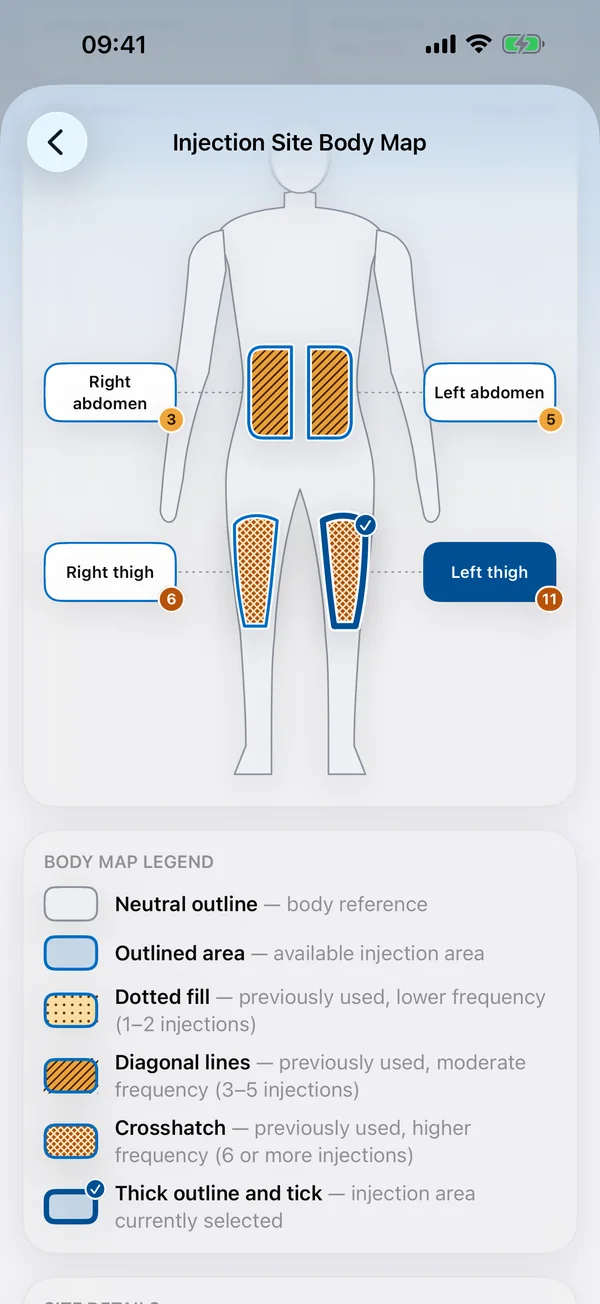
GLPMGR is a private GLP-1 tracker for iPhone, iPad and Apple Watch. Choose Zepbound when you record a dose and it offers only the areas above for your region, shows a body map of where you have injected before, and shows the manufacturer’s rotation wording. It also follows your dose steps, reminds you when a dose is due, and keeps a note of side effects. It does not tell you where to inject, and it is independent of Eli Lilly.
Other medicines with the same active ingredient:
Medical disclaimer
Talk to a healthcare professional. The injection areas shown come from the manufacturer's product information, and the shading shows where you've injected before. GLPMGR is not a medical device and this is not medical advice: it can't tell you where it is safe for you to inject. Talk to your doctor, pharmacist or nurse about where and how to inject, follow the instructions from your prescriber and the leaflet supplied with your medicine, and ask a healthcare professional if you are unsure, or if you have pain, lumps, bruising or any other problem at an injection site.